What this retreat is about
EE Alignment Retreat 3.0 is four days of sessions, co-created by the people who attend.
A constitution alone cannot align a government with its citizens. The culture has to do part of the work, and every citizen has a role in it.
We think the same holds for AI. To address misaligned AI, we want to start by aligning ourselves. Then we extend that alignment outwards: to our community, our environment and, in time, our technology.
The sessions range from walks in the nearby forest, yoga, meditation and circling to making sense of the state of the world. In some workshops we check which parts of our work we want to automate and which parts we want to do ourselves. When we rush to solve a problem, we miss how it connects to other things, and our solution creates new problems.
This is a bottom-up event in the style of an unconference. If your interest lies outside these topics, propose your own session.
Dates
- Q&A call. Wednesday 7 October, 8 to 9 pm IST.
- Expression of interest form. Fill it by 10 October.
- Retreat. Mid November to early December 2026. These dates are tentative, and we are still considering them.
When, where and cost
- When. One of four windows: 13-16 November, 20-23 November, 27-30 November or 4-7 December 2026. We will pick the window from the form responses.
- Where. Ooty, in the Nilgiris.
- Cost. About Rs 16,000 per person, which is around Rs 4,000 a night. We have limited funding for people who cannot afford the cost.
- Longer stays. The four days are compulsory. You can arrive earlier or stay longer at the same daily rate. We will be there three days before the retreat and a week after it.
We plan to run more retreats on other dates and in other places. Fill the form even if these dates do not work for you.
How it started
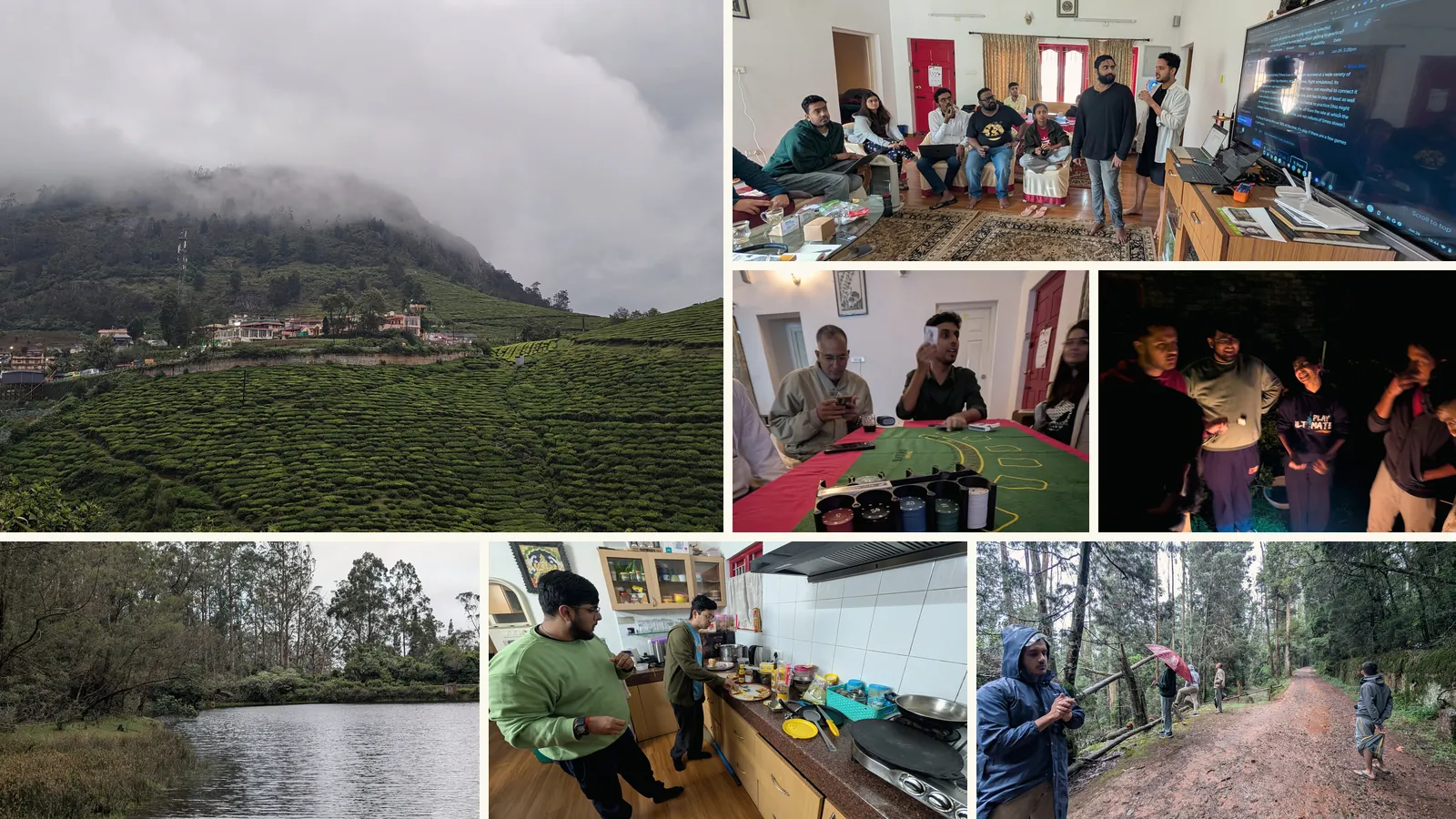
The first retreat was in June 2024. One of us offered a house in Ooty to a group of friends who wanted to make sense of AI. It grew from a side project called Horcruxes for Humanity, which looked for ways to stay resilient to black swan events. We wrote poems, debated, made predictions and walked around Ooty.
Ooty 2.0, in June 2025, kept those roots. It had prediction markets, a workshop on Bayesian thinking and a lot of vibe coding. Between them we put grounding sessions: yoga, meditation, circling, and talks on Buddhism and the metacrisis. We also discussed how to help our families and friends through the coming intelligence revolution.
Some of the vibe coding became projects that still run, such as Simulacra and Live Conversational Threads. Read our reflections from Ooty 2.0 on LessWrong.
Now we want to keep the tradition alive and open it to a wider group. Join us for the third iteration.
What we noticed
- People felt free to drop their masks. Conversations, arguments and debates were honest, and it was a relief to stop playing status games.
- Slowing down helped. With time and the sustained attention of a group, we went deep into hard questions and did not feel overwhelmed.
- Things kept going afterwards: friendships, collaborations, and projects that started as weekend experiments.
We hope to grow a community in India that practises alignment in this broader sense, with room for rich friendships and good collaborations.
We value decentralised, local work on the ground. Money, talent and attention in AI safety flow through a few pipelines that are linked to each other. Even when everyone involved is sincere, that makes it easy for everyone to defer to the same views. We want spaces where people make sense of AI on their own terms. That includes approaches to alignment that differ from the dominant ones in rationalist and EA circles.
Themes
Participants host the sessions, so the structure grows from what they bring. These are the themes we hope to see. Under each theme are sessions that people have proposed so far. They are early drafts, and the schedule is still open.
Embodiment and integrity
Talk about alignment tends to stay intellectual and conceptual. We want time away from conversations, writing and code: in nature, walking, moving, staring at the sky. Then the whole body takes part in our decisions.
Expect meditation, yoga, treks and optional circling. The key question: how far do you live by the beliefs you hold, and if you struggle to, why?
- Hammer time. Peer-to-peer problem solving and star circling.
Cognitive gym
AI makes it easy to skip the struggle, and the struggle is where the learning happens. How do we keep our minds fit when AI can do so much of our thinking? We would also love interactive explainers. If you understand something well, build something that helps the rest of us understand it. Think of Bret Victor, 3Blue1Brown and Nicky Case.
- Co-writing session. Timed writing without AI, with feedback from each other, on realistic fiction about the next 30 years. Writing and thinking are the same.
- Hands-on puzzles. No AI, no phones. A robot arm, Turing Tumble, Spintronics, maths puzzles, and a game coded by hand on paper.
Sensemaking and forecasting
What is happening in the world, where is it heading, and what follows from what you believe? We like falsifiable predictions. We change our minds when reality shows us where we were wrong.
- State of the world mapping. Politics, climate, AI, wars, the economy and more, mapped together on a big canvas.
- Debate (Stoa). One big question, everyone’s position and confidence, then red-teaming, cruxes and predictions. Candidate questions: Is the fertility crisis a big deal? Are technical approaches to AI safety more important than the others? Should we grant AIs personhood?
- Five-year plans. Plans for several AI futures at once. What does each future mean for education, meaning, money and relationships, and for India in particular?
Metacrisis
Is there a shared operating system behind the major crises humanity faces? Does the way we innovate and solve problems create new problems? What would it mean to work at the level of causes?
- Crisis generator functions. Looking for the patterns behind the crises, and for ways to act that help more than they harm.
Education
What does it mean to be educated in a world transformed by AI? What should young people learn, and what should schools and universities become?
- Goals of education. Builds on an online discussion group from earlier this year, on education in a post-AGI world.
Technology in daily life
When doing becomes easy, how and why we do it matters more. How do we keep our tools working for what we want?
- Interface integration therapy. 30 minutes of one-to-one help to automate the parts of your work you dread, or to change your habits around devices.
Community and cooperation
AI makes building cheaper, and a small grant goes further than it did a few years ago. What should a community like ours fund and build together, and how would we know it helped? We plan to launch our own request for proposals to support independent researchers and projects in India.
We believe communities and relationships will matter more as traditional institutions come under strain. AI empowers the individual more than the collective. We want to explore how to mitigate this, or be proven wrong.
- Tools for community cooperation and resilience. What to fund, how to measure impact with honesty, and whether a small Manifund-style granting group makes sense for us.
Bring your own session
Everyone comes with something to give: a rough thought, a half-baked idea, an unreleased project. You choose the prompts and the format. A session can be a discussion or a debate. You can also ask the group to help you or to teach you.
A session can be non-technical. Past retreats had poetry writing, a deep reading of an article, a movie, and marshmallows over a bonfire. People also made detailed falsifiable predictions about AI capabilities, gave lightning talks, and designed test suites for frontier models.
Who we are
Epistemic Experiments is an independent community initiative. We organise this retreat ourselves, without formal ties to any larger institution.
Questions
Is this all about AI?
No. We would run this retreat even if AI was a small matter. The world has other problems that need inner alignment.
What kind of people can I expect?
Expect a varied group. Last time we had people who work in neuroscience and mental health, entrepreneurs, ML interpretability researchers, and people who taught us yoga.
Who are you, and why do you run this?
We are a group of friends who like to act on the challenges we face, and we want our community to grow. Vatsal runs rationality workshops and Portal. Aditya is a well-known AI safety community builder in India. Bhishma is an enthusiast of AI safety and of navigating the impact of AI.
Aditya and Bhishma have followed AI safety since 2022. For the past three years they have run awareness events at IIIT Hyderabad, IIT Madras and EAGx. We keep asking whether there are more people like us. This retreat is our attempt to find you.
Must I run a session?
Yes. Everyone comes with something to give. A session can be a talk, a game, a puzzle or an open question, and we accept sessions that are half finished.
Can I come for part of the retreat?
No. You can arrive earlier or stay longer.
Does the form commit me to come?
No. The form tells us that you are interested and which dates work for you. It takes 5 to 15 minutes, which depends on how much you like to write. Fill it by 10 October.
What should I do next?
- Come to the Q&A call on Wednesday 7 October, 8 to 9 pm IST.
- Write to admin@epistemic-experiments.org if you want more information.
- Fill the expression of interest form by 10 October.
Links
- Expression of interest form. It takes 5 to 15 minutes.
- Q&A call. Come to meet us and ask questions.
- Slido. Post your questions for the Q&A call here.
- Events sheet. Add your name, propose a session, or join a session that someone else proposed.
- Retreat doc. More about our motivations and the themes.
- Reflections from Ooty Retreat 2.0. What the last retreat was like.
- Discord. Hear about events like this one.
- admin@epistemic-experiments.org. Write to us for more information, or to book a call with the organisers.
Comments
This page supports public annotation through Hypothesis. Turn it on, select any text, and choose Annotate. Sign in if prompted.